
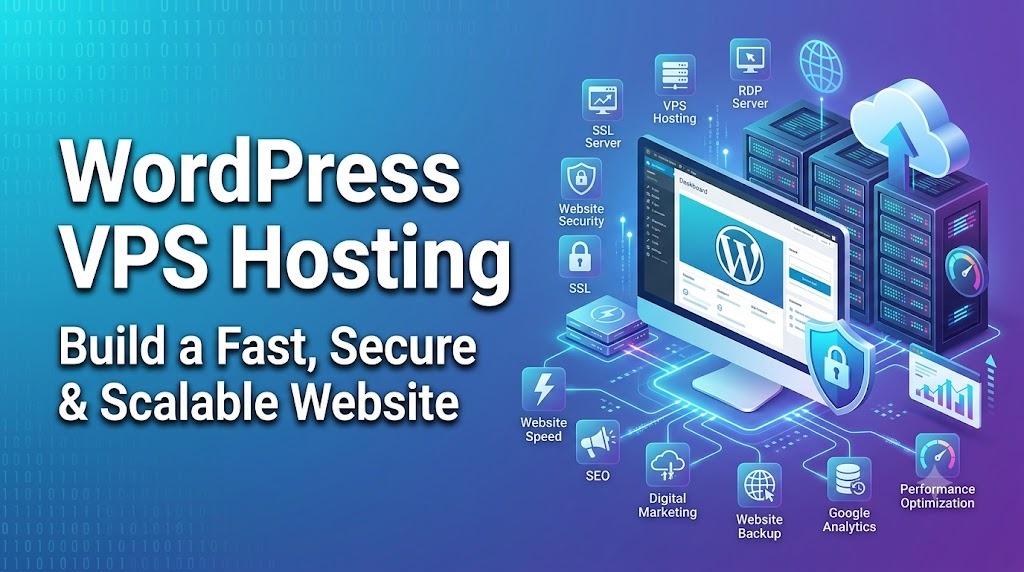
WordPress VPS Hosting: The Complete Guide to Building a Fast, Secure, and SEO-Driven Business Website.
In today's digital world, simply having a website is no longer enough to stand out. Customers expect websites to load quickly, remain secure, deliver a seamless user experience, and rank well on search engines. If your website is slow, difficult to navigate, or vulnerable to security issues, potential customers may leave before they even learn about your products or services.
Building a successful online presence requires more than just attractive design. Your website's foundation—including reliable hosting, strong security, search engine optimization (SEO), and an effective digital marketing strategy—works together to determine its long-term success.
This guide explains how WordPress VPS Hosting, VPS Hosting, RDP Server technology, and Digital Marketing complement one another to create a scalable, high-performing, and conversion-focused business website. Whether you're launching your first website or planning to upgrade your existing infrastructure, you'll discover practical strategies that can help improve website performance, user experience, and business growth.
What Is WordPress?
WordPress is the world's most popular content management system (CMS), powering millions of websites across blogs, business websites, eCommerce stores, portfolios, educational platforms, and corporate portals.
Its popularity comes from its flexibility, user-friendly interface, and extensive ecosystem of themes and plugins that allow businesses to create professional websites without building everything from scratch.
With WordPress, website owners can easily:
- Publish and manage content
- Customize website design
- Install SEO plugins
- Add contact forms
- Build landing pages
- Launch online stores
- Improve website functionality
Its scalability makes WordPress suitable for both small startups and large enterprises.
Why Businesses Choose WordPress
Businesses prefer WordPress because it balances simplicity with powerful customization.
Some major advantages include:
- Easy content management
- Mobile-responsive themes
- Thousands of plugins
- Strong community support
- Excellent WordPress SEO capabilities
- Flexible customization options
- Regular updates and improvements
Because WordPress supports Technical SEO and integrates with numerous marketing tools, it provides a strong foundation for long-term online growth.
What Is VPS Hosting?
VPS (Virtual Private Server) Hosting is a hosting solution where one physical server is divided into multiple independent virtual servers. Each virtual server receives dedicated resources such as CPU, RAM, and storage.
Unlike shared hosting, your website does not compete heavily with neighboring websites for resources.
As traffic grows, VPS Hosting offers greater stability, improved Website Performance, and better security.
Businesses often migrate to VPS Hosting once their websites begin receiving consistent traffic or require more control over server configurations.
Some organizations also choose managed VPS providers, including solutions such as GORDP, to simplify server management while maintaining performance and flexibility.
| Feature | Shared Hosting | VPS Hosting |
|---|---|---|
| Resources | Shared among multiple websites | Dedicated virtual resources |
| Performance | May fluctuate | More stable and consistent |
| Website Speed | Slower during peak traffic | Faster under heavy loads |
| Security | Shared environment | Better isolation |
| Customization | Limited | High level of control |
| Scalability | Limited | Easily scalable |
| Best For | Small personal websites | Growing businesses and professional websites |
If your website generates leads, processes customer information, or handles increasing visitor numbers, VPS Hosting usually provides a more reliable foundation.
Benefits of VPS Hosting
Choosing the right hosting environment directly impacts website success.
Some important benefits include:
Improved Website Speed
Dedicated resources allow pages to load faster, creating a smoother experience for visitors and reducing bounce rates.
Better Website Performance
Consistent server resources help maintain reliable performance even during traffic spikes.
Greater Security
Virtual server isolation reduces risks associated with neighboring websites sharing the same environment.
Scalability
Businesses can increase server resources as website traffic and business requirements grow.
More Control
Advanced users can configure server settings according to their application's needs.
What Is an RDP Server?
RDP stands for Remote Desktop Protocol.
An RDP Server enables users to securely access a remote Windows server from virtually anywhere using an internet connection.
Instead of physically sitting in front of the server, administrators can manage websites, software, databases, backups, and development environments remotely.
For agencies managing multiple client websites, an RDP Server can significantly improve operational efficiency.
Business Uses of RDP
Businesses use RDP for many practical purposes, including:
- Managing WordPress websites remotely
- Performing software updates
- Uploading website files
- Monitoring server performance
- Running scheduled maintenance
- Managing backups
- Accessing business applications securely
- Supporting remote development teams
When paired with VPS Hosting, RDP provides a convenient way to administer websites without needing physical access to the server.
Solutions like GORDP are commonly considered by businesses seeking reliable remote server access alongside VPS environments.
Why Website Performance Matters
Website Performance influences almost every aspect of online success.
A high-performing website offers:
- Better user experience
- Improved customer satisfaction
- Lower bounce rates
- Higher engagement
- Better search engine visibility
- Increased conversions
Performance is no longer just a technical concern—it is a business advantage.
Website Speed and User Experience
Website Speed is one of the first impressions visitors have of your business.
Slow-loading websites often result in frustrated users who leave before interacting with your content.
To improve Website Speed:
- Use lightweight themes
- Remove unnecessary plugins
- Compress CSS and JavaScript
- Enable browser caching
- Optimize images
- Upgrade hosting when necessary
Every second saved contributes to a smoother browsing experience.
Understanding Core Web Vitals
Core Web Vitals are performance metrics that measure real user experience.
The three primary metrics include:
Largest Contentful Paint (LCP)
Measures how quickly the main content becomes visible.
Interaction to Next Paint (INP)
Measures how responsive the website feels when users interact with it.
Cumulative Layout Shift (CLS)
Measures visual stability while the page loads.
Optimizing these metrics helps improve usability and supports stronger search engine performance.
WordPress SEO: Building a Search-Friendly Website
WordPress SEO involves optimizing your website so search engines can understand and rank your content effectively.
Key practices include:
- Writing descriptive page titles
- Creating informative meta descriptions
- Using heading hierarchy correctly
- Optimizing internal linking
- Publishing valuable content
- Improving page speed
- Creating SEO-friendly URLs
- Using image alt text
Effective WordPress SEO focuses on helping users find accurate, valuable information rather than simply targeting keywords.
Why Technical SEO Matters
Technical SEO ensures that search engines can efficiently crawl, index, and understand your website.
Important Technical SEO elements include:
- XML sitemaps
- Robots.txt configuration
- HTTPS implementation
- Structured website architecture
- Canonical URLs
- Mobile optimization
- Crawl error monitoring
- Schema markup where appropriate
Even outstanding content may struggle to rank if technical issues prevent search engines from properly accessing your website.
Content Marketing Drives Sustainable Growth
Content Marketing helps businesses attract, educate, and convert potential customers.
Instead of relying solely on advertisements, businesses create valuable content such as:
- Blog articles
- Tutorials
- Case studies
- Product guides
- Industry insights
- Educational resources
Consistent publishing builds credibility while supporting long-term organic search visibility.
Quality content also provides more opportunities to rank for relevant search queries.
Landing Pages and Lead Generation
A Landing Page focuses on a single objective, such as collecting inquiries, encouraging downloads, or promoting a specific service.
Effective Landing Page Optimization includes:
- Clear headlines
- Strong value proposition
- Simple forms
- Visible call-to-action buttons
- Trust signals
- Mobile responsiveness
- Fast loading speed
When combined with Digital Marketing campaigns, optimized landing pages become powerful Lead Generation tools.
Email Marketing Builds Long-Term Relationships

While attracting visitors is important, retaining customers is equally valuable.
Email Marketing helps businesses:
- Share new content
- Announce product updates
- Promote special offers
- Educate subscribers
- Nurture leads
- Encourage repeat business
Collecting email subscribers through optimized landing pages creates opportunities for ongoing customer engagement.
Measuring Success with Google Analytics and Google Search Console
No marketing strategy is complete without measurement.
Google Analytics helps businesses understand:
- Visitor behavior
- Traffic sources
- Conversion rates
- User engagement
- Popular content
Meanwhile, Google Search Console provides insights into:
- Search performance
- Keyword visibility
- Indexing status
- Crawl errors
- Mobile usability
- Core Web Vitals reports
Together, these tools help website owners make informed decisions based on real data rather than assumptions.
Website Security Should Never Be Ignored
Security is essential for protecting customer trust and business continuity.
Common security practices include:
- Strong passwords
- Multi-factor authentication
- Regular software updates
- Security monitoring
- Malware scanning
- Firewall protection
- Limited administrator access
A secure website reduces the risk of data loss and service interruptions.
SSL Certificates Protect Visitor Data
An SSL Certificate encrypts communication between visitors and your website.
Benefits include:
- Secure data transmission
- Improved customer confidence
- HTTPS encryption
- Better browser trust
- Support for modern SEO best practices
Every business website should use HTTPS as a standard security measure.
Website Backup Protects Your Business
Unexpected issues can occur because of hardware failures, software conflicts, accidental deletions, or cyberattacks.
Regular Website Backup practices ensure that your website can be restored quickly if something goes wrong.
Many businesses schedule automatic daily backups while also storing copies in separate locations for added protection.
Caching, CDN, and Image Optimization
Performance optimization involves several complementary techniques.
Caching
Caching stores frequently requested content so pages load faster for returning visitors.
CDN
A Content Delivery Network (CDN) distributes website files across multiple global servers, reducing loading times for users in different geographic locations.
Image Optimization
Large images often slow websites significantly.
Compressing images, using modern formats, and serving appropriately sized images helps improve Website Performance without sacrificing quality.
Performance Optimization Best Practices
Improving performance is an ongoing process rather than a one-time task.
Useful optimization techniques include:
- Regular plugin audits
- Database optimization
- Minifying CSS and JavaScript
- Lazy loading images
- Choosing quality WordPress Hosting
- Monitoring uptime
- Updating software regularly
Reliable infrastructure—including well-configured VPS Hosting and dependable providers such as GORDP when appropriate—can support these optimization efforts.
The Role of AI in Digital Marketing

Modern Digital Marketing increasingly uses AI-powered tools to assist with tasks such as audience analysis, campaign optimization, personalization, customer support, and performance reporting.
Businesses can use these technologies to identify trends, improve targeting, and make data-informed decisions while continuing to focus on creating valuable experiences for customers.
A Realistic Business Example
Imagine a growing home décor business launching its online store.
The business chooses WordPress because it allows easy product management and content publishing.
As traffic increases, the company upgrades from shared hosting to VPS Hosting to improve Website Speed and stability.
The technical team uses an RDP Server to remotely manage updates, monitor performance, and maintain server security.
The marketing team publishes educational blog posts, optimizes product pages with WordPress SEO, creates landing pages for seasonal campaigns, tracks visitor behavior using Google Analytics, monitors search visibility through Google Search Console, and builds an email subscriber list.
Together, these technologies create a faster, more secure, and conversion-focused online business.
Common Beginner Mistakes
Many new website owners unintentionally limit their website's potential.
Common mistakes include:
- Choosing hosting based only on price
- Ignoring Technical SEO
- Publishing low-quality content
- Installing too many plugins
- Skipping website backups
- Neglecting security updates
- Failing to optimize images
- Not tracking website performance
- Overlooking mobile optimization
Avoiding these mistakes saves time, improves user experience, and supports sustainable growth.
Practical Checklist for Building a High-Performing Website
Use this checklist before launching or upgrading your website:
- Choose reliable WordPress VPS Hosting.
- Install an SSL Certificate.
- Configure automatic website backups.
- Optimize images before uploading.
- Enable caching.
- Use a CDN for global performance.
- Improve Core Web Vitals.
- Follow WordPress SEO best practices.
- Fix Technical SEO issues regularly.
- Create valuable Content Marketing consistently.
- Build conversion-focused landing pages.
- Track performance using Google Analytics.
- Monitor search visibility with Google Search Console.
- Keep WordPress, themes, and plugins updated.
- Review website security on a regular schedule.
Best Practices for Long-Term Success
Successful websites continue evolving after launch.
Focus on:
- Publishing valuable content consistently
- Monitoring Website Performance
- Improving Website Speed regularly
- Updating security measures
- Testing landing page improvements
- Reviewing SEO performance
- Scaling hosting resources when traffic increases
- Making decisions based on analytics instead of assumptions
Continuous improvement is one of the biggest competitive advantages for any online business.
Conclusion
A successful website is built on much more than attractive design. WordPress provides the flexibility to create and manage professional websites, while VPS Hosting delivers the speed, scalability, and reliability required for business growth. An RDP Server simplifies remote administration, and Digital Marketing strategies help attract, engage, and convert the right audience.
When these technologies work together alongside strong Website Security, Technical SEO, Content Marketing, performance optimization, and data-driven decision-making, businesses create websites that are faster, more secure, easier to manage, and better positioned to succeed in search results.
Whether you're launching a new business website or upgrading an existing one, investing in the right hosting environment, optimizing every aspect of website performance, and following proven SEO and marketing best practices will help you build a secure, high-performing online presence that delivers lasting value. Start implementing these strategies today and take the next step toward creating a website that not only ranks well but also earns trust, generates leads, and supports sustainable business growth.