


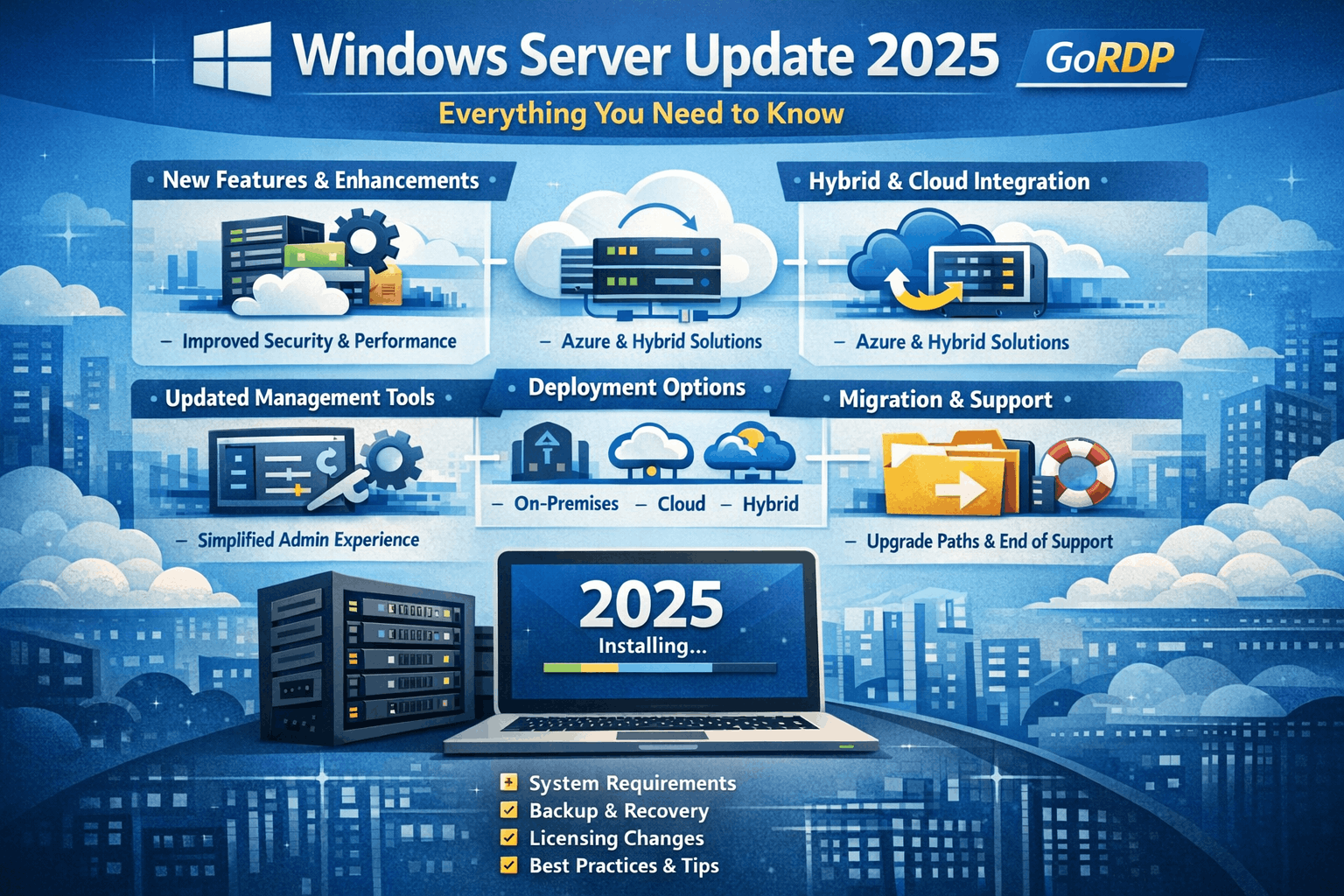
Windows Server Update 2025: Everything You Need to Know
Windows Server 2025, released on November 1, 2024, represents Microsoft’s most significant server update in years, introducing groundbreaking features like hotpatching, advanced AI capabilities, and enhanced security. This latest version delivers major improvements across virtualization, storage performance, and hybrid cloud integration while maintaining support through October 2034.
Release Details and Availability
Microsoft made Windows Server 2025 generally available starting November 1, 2024, after months of testing through the Windows Insider program that began in January 2024. The operating system is available through the Long-Term Servicing Channel (LTSC) with 10 years of mainstream support ending October 10, 2029, and extended support until October 10, 2034. Organizations can access a free 180-day trial through the Microsoft Evaluation Center to test the new features before purchasing.
Major New Features and Enhancements
Hotpatching Without Reboots
The standout feature of Windows Server 2025 is hotpatching, which allows administrators to apply security updates without system reboots. This capability patches the in-memory code of running processes, ensuring higher availability for mission-critical systems. Previously available only for Azure Edition since 2022, hotpatching now extends to on-premises and multicloud environments when servers connect to Azure Arc. Microsoft’s Xbox team reported reducing update cycles from weeks to days using this technology.
Performance Improvements
Windows Server 2025 delivers up to 60% more storage IOPs performance compared to Windows Server 2022 on identical hardware. The system now supports DirectStorage technology, providing 2.4x faster I/O operations and 70% lower latency. Maximum scalability increased dramatically with support for 256 CPU cores (up from 128) and 64TB of RAM (up from 48TB), making it ideal for AI workloads, development environments, and high-performance computing.
Enhanced Security Features
Security receives a comprehensive overhaul with multiple new protections:
-
Credential Guard: Now enabled by default on compatible devices, blocking credential theft attacks by protecting NTLM password hashes, Kerberos Tickets, and domain credentials
-
SMB Security Hardening: Includes hardened firewall defaults, brute force attack prevention, and protections against man-in-the-middle, relay, and spoofing attacks
-
Virtualization-Based Security (VBS) Enclaves: Helps applications protect secrets by removing admin trust requirements and hardening against malicious attacks
-
Zero-Trust Security Model: Integrated throughout the platform to safeguard against evolving cyber threats
Active Directory Improvements
Windows Server 2025 introduces next-generation Active Directory capabilities including AD object repair, optional 32KB database page size (doubling the previous 16KB limit), and improved security for confidential attributes. Delegate Managed Service Accounts (dMSA) eliminate manual password management by having AD automatically handle credentials.learn.microsoft+1
Editions and Licensing
Available Editions
Windows Server 2025 comes in two primary editions with distinct capabilities:brytesoft+1
| Feature | Standard Edition | Datacenter Edition |
|---|---|---|
| Base Price | $599 (license only) | $1,499.99-$6,771 |
| Virtual Machines | Up to 2 VMs | Unlimited VMs |
| Core-Based Licensing | Required (16 core minimum) | Required (16 core minimum) |
| Software-Defined Networking/Storage | Not included [brytesoft] | Included |
| Best For | Small to mid-sized businesses | Large-scale virtualization |
Licensing Requirements
Both editions require core-based licensing with a minimum purchase of 16 cores per server and 8 cores per processor. Client Access Licenses (CALs) are mandatory, priced at approximately $39.99 per User CAL or $38.99 per Device CAL, with 5-packs available at $189.95. Microsoft also offers CSP Subscription options with 1-year and 3-year terms for flexible licensing.
System Requirements
Windows Server 2025 requires modest hardware but introduces new processor instruction requirements:
-
Processor: 1.4 GHz 64-bit with x64 instruction set, SLAT, NX, DEP, CMPXCHG16b, LAHF/SAHF, PrefetchW, SSE4.2, and POPCNT instruction (new requirement)
-
Memory: 512 MB for Server Core; 2 GB minimum (4 GB recommended) for Server with Desktop Experience
-
Storage: 32 GB minimum, with additional space needed for systems using more than 16GB RAM
-
Virtual Machine: 800 MB or more allocated memory recommended
Virtualization and Cloud Integration
Windows Server 2025 delivers major advancements for Hyper-V, GPU integration, Storage Spaces Direct, software-defined networking, and clustering. Accelerated Networking (AccelNet) simplifies single root I/O virtualization (SR-IOV) management for virtual machines, using high-performance data paths to reduce latency, jitter, and CPU utilization.
Enhanced containerization support provides robust capabilities for container technologies and microservices, crucial for modern cloud-native applications. This improves deployment speed and efficiency for developers working with hybrid and multicloud architectures.
Additional Notable Features
-
Block Cloning Support: Dev Drive uses ReFS file system format with block cloning for significant performance benefits when copying files
-
DTrace Integration: Native command-line utility for real-time system performance monitoring and troubleshooting
-
SMB over QUIC: Alternative port support allows switching from default UDP/443 to any other port for secure Internet file share access
-
Performance Counters: New monitoring capabilities for DC Locator, LSA Lookups, and LDAP client operations
FAQs
Q: When was Windows Server 2025 released?
Windows Server 2025 became generally available on November 1, 2024, with support continuing through October 2034. Microsoft offers a free 180-day trial for organizations wanting to test the platform before purchasing.wikipedia+1
Q: What is hotpatching in Windows Server 2025?
Hotpatching allows security updates to be applied without system reboots by patching in-memory code of running processes. This feature requires Azure Arc connectivity and Virtualization-Based Security (VBS) enabled, dramatically reducing downtime for critical servers.
Q: How much does Windows Server 2025 cost?
Windows Server 2025 Standard starts at $599 for the base license, while Datacenter edition ranges from $1,499.99 to $6,771 depending on configuration. Both require 16-core minimum licensing plus Client Access Licenses (CALs) at approximately $39.99 per user.
Q: What are the major improvements over Windows Server 2022?
Key improvements include 60% better storage performance, support for 256 CPU cores (vs 128), 64TB RAM capacity (vs 48TB), hotpatching capability, enhanced security with default Credential Guard, and advanced containerization support.